 76
Planisphere
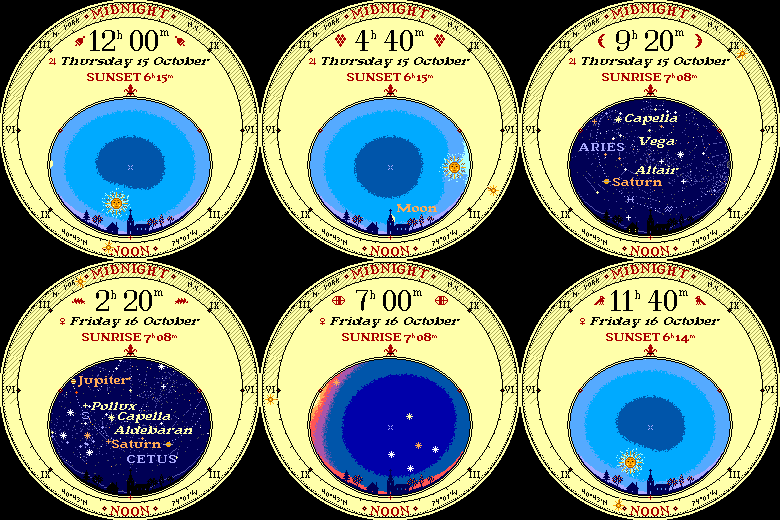
FacesPlanisphere is a star chart and an almanac: the two ways people have kept the sky and the year for two thousand years. The chart is a planisphere, Ptolemy's heavens laid flat on a disc, the turning rete of a medieval astrolabe, the paper star wheel of the 1900s. Your own sky turns behind the card's oval window, with the Moon in its phase, the planets and the Milky Way, and the Sun rides the ring as the hour hand. Read it facing south, as any star chart: east is on its left. The weather, from Open-Meteo, drifts over the village below. Eclipses are drawn as they happen. The almanac is after the shepherds' calendars of the 1490s. Its line gives the next sunrise or sunset and the sky's news: planets meeting, a meteor shower. Keep any of twelve calendars and their days are named there, the great ones in red as in the Books of Hours: the Christian and Eastern years, old English customs, the fire festivals, ancient Rome, the United States, Britain and Ireland, and the Hebrew, Chinese, Islamic and Hindu calendars. Each has its emblem, after the old carved calendar sticks; some light every window or fires on the hills, some bring fireworks each evening hour. Christmas Eve names its first star; at Qixi the magpies bridge the Weaver and the Cowherd; a rabbit sits in the Mid-Autumn moon. Ten plates after real charts and instruments: a paper planisphere, Burritt's atlas (1835), Flamsteed's (1729), an astrolabe, a Book of Hours, Prague's clock (1410), a cyanotype, Apian's woodcut (1540), a red night-vision plate, a plain night. A settings page shows the face live as you choose.
 8
Morphogen 9
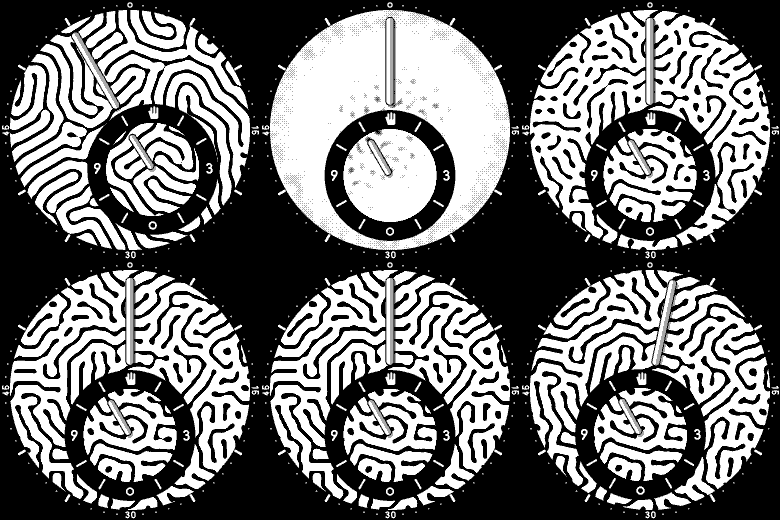
FacesMorphogen 9 is a watchface whose dial is alive. Its pattern is a Turing pattern, the reaction and diffusion that paint a zebra's stripes and a pufferfish's maze, grown on the watch itself. The whole dial turns once an hour and carries the minute hand; the hour disc orbits opposite it. At the top of every hour the old lines melt away and a new pattern grows out from the centre, spots stretching into worms that wiggle into place: fingerprint swirls, labyrinths, coral, dots, turning spiral waves, or a true maze whose walls grow as one tree, so every corridor can be reached by just one way. Between hours it can stay alive, creeping a little each minute, and a flick of the wrist heals a patch or shows the seconds. Everything is yours to set, on a page that shows the face live as you choose and grows a new pattern on demand: the pattern, its size (even or graded across the dial) and lines; a small disc with the moon's phase, the battery, your steps, your heart rate, the weather or a second time zone; a date; ten hand styles; the emblem at 12; Arabic or Roman numerals; 58 colour themes with gradients, or themes of your own to keep and share; a night theme and quiet nights; an hourly chime; a red hour ring when the phone is away, amber when the battery is low. For Pebble Time 2 and Pebble Round 2.
 30
Groundtrack Fuller
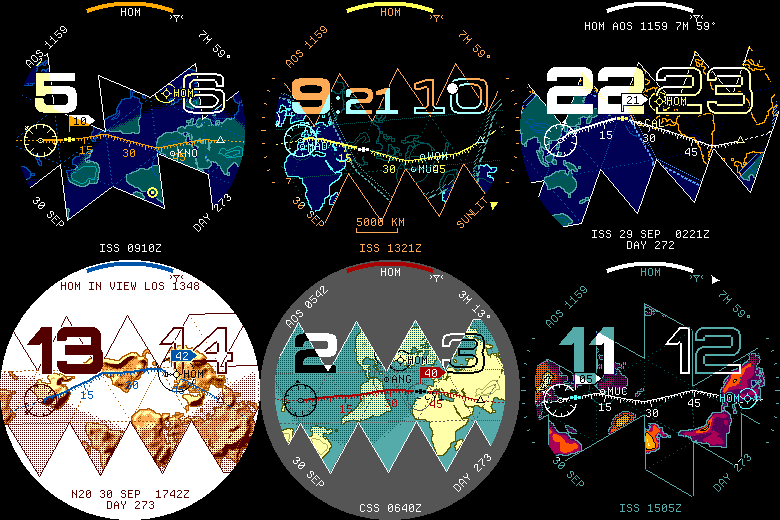
FacesGroundtrack Fuller draws where the Sun, the Moon or a satellite is over the Earth, and where it goes next, on Buckminster Fuller's unfolded globe with the time set along the route. The icosahedron rolls across the screen under the route, printing each face as it touches down, so the route never meets a cut: a satellite's hour unrolls into a band of faces, the Sun's or Moon's day into a strip across the net. Tracking stations in reach are ringed, and so is home. Follow one of 68 satellites, from space stations and Starlink to GPS and weather, or find any other at CelesTrak. The Sun and Moon can be marked beside it. Relief and coastlines come from public-domain elevation data on the watch; the calculated Sun brings night across the net. Thirty-two plates, from paper charts and a portolan to mission-control glass, cockpit HUDs and the Earth at night. A fuel line shows battery and phone link; the watch can buzz when the link drops. Brief animations, each its own switch: the body blinks as it steps, scans refresh, pixel-sort or reacquire screen-like plates, and a flick moves between the satellites you follow. For Pebble Time 2 and Pebble Round 2: on the round screen the margins letter round an octagon, run in chords over a map to the edge, or tick the minutes like an instrument. Its companion, Groundtrack, draws the same routes on a flat map; the two can be installed side by side. The phone sends the Sun and Moon weeks ahead and orbits days ahead, so the face runs without it. Not for navigation. Source code is on GitHub.
 36
Groundtrack
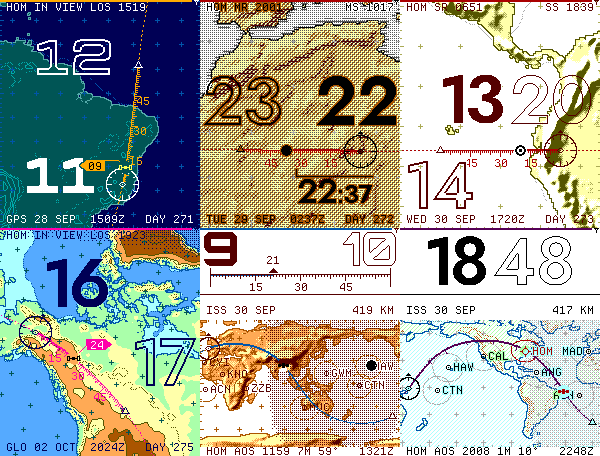
FacesGroundtrack draws where the Sun, the Moon or a satellite is over the Earth, and where it goes next, on a flat chart with the time set along the route. Two faces in one. Enroute is an hour chart: the ground track from this hour's compass rose to the next reporting point, marked each minute. The Plotboard is mission control's wall: a world band with tracking stations and the time on a ruler, tape or clock. Follow one of 68 satellites, from space stations and Starlink to GPS and weather, or find any other at CelesTrak. The Sun and Moon can be marked beside it. Relief and coastlines come from public-domain elevation data on the watch; the calculated Sun brings night across the map. A home station gives sunrise and sunset or the satellite's next pass. Thirty-two plates, from paper charts and a portolan to mission-control glass, cockpit HUDs and the Earth at night. A fuel line shows battery and phone link; the watch can buzz when the link drops. Brief animations, each its own switch: the body blinks as it steps, scans refresh, pixel-sort or reacquire screen-like plates, and a flick moves between the satellites you follow. For Pebble Time 2 and Pebble Round 2: on the round screen the margins letter round an octagon, run in chords over a map to the edge, or tick the minutes like an instrument. Its companion, Groundtrack Fuller, draws the same routes on Buckminster Fuller's unfolded globe; the two can be installed side by side. The phone sends the Sun and Moon weeks ahead and orbits days ahead, so the face runs without it. Not for navigation. Source code is on GitHub.
 80
Dymaxion
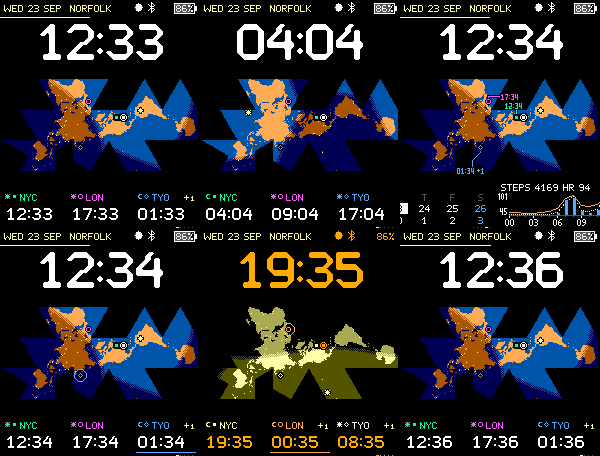
FacesA watch face built on Buckminster Fuller's Dymaxion map, which unfolds the globe onto the twenty faces of an icosahedron without splitting a continent. Fuller called it a deck plan of Spaceship Earth: one island in one ocean, with no country at the center. Sunlight crosses the map through the day; city lights come on at night. An optional Moon marks where it is overhead, shaded for its phase. Turn the map 180° while keeping its labels upright. Up to three other time zones can sit in the bottom panel, beside the clock, between the clock and map, or by each city on the map. Daylight saving is handled per zone. The bottom panel offers weather, sunrise and sunset, a two-week calendar, humidity, tides and Pebble Health. Tides follow the nearest NOAA station as you travel, or Open-Meteo's modelled sea level anywhere else. Panels change on a wrist flick, a timer, or when rain or a turning tide approaches. The top bar has its own Moon, battery gauge, Quiet Time mark and step line. Choose from twenty-five palettes, custom colors and eight clock typefaces, with a preview in the phone settings. Fuller's word for doing more with less was ephemeralization. The map is redrawn at an interval rather than every minute, and a power saver cuts redraws at night or during Quiet Time. The face and its settings speak 19 languages, including Chinese, Japanese, Korean, Russian and Arabic. Requires Pebble Time 2. Automatic city, weather and tides use the phone's location. Health stays on the watch. Screenshot weather and tides are examples. Source code is on GitHub.