 9
9BrewSession
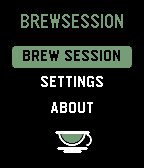
Tools & UtilitiesA tea timer that knows which infusion you're on. Set a custom steep time as fast as the stock timer - no tea database, no menu asking which infusion this is. Hit Start and pour during the felt countdown: a tick on your wrist each second, one long buzz at "go." When the steep ends the watch buzzes until you shake it off. Come back for round two and the app already knows - "Infusion 2" is waiting with its time computed. The per-infusion increment is asked for exactly once, and only when you commit to a second infusion. If you never brew one, you're never asked. Steeping shorter as you go? Negative increments are first-class. * Recents are the presets: your last sessions, one press to rebrew * The on-screen teacup fills with tea as the steep runs * Skip infusions, adjust a running steep +/-5s, abandon with a long press * The alarm survives the app being closed - a scheduled wakeup relaunches it at the right moment * Hand-drawn tabular digits, so the countdown never shimmies * Touch on Pebble Time 2: drag the picker wheel, tap to start, tap to dismiss - and every button still does what it always did * A setting to open straight into your brew session No phone connection needed after install.
 4
4Berean Bible
DailyThe whole Bible on your wrist. Berean Bible reads the Berean Standard Bible - a clear, modern, public domain translation - with nothing between you and the text: open it and you're reading, exactly where you left off. Chapters arrive through your phone from the fetch.bible CDN and are cached as you go, so the books you actually read are there when you want them. The text keeps its shape: prose paragraphs open with a gentle indent, the Psalms keep their poetry line by line, and superscriptions and Psalm 119's Hebrew letters stand where they've always stood. Say where you want to go. Press Search and speak - "John 3", "Psalm 23", "First Corinthians 13" - and you're there, even if you've never opened that book before. Speak a phrase instead - "for God so loved the world" - and get tappable results with the verse reference, each one opening the chapter scrolled to that very verse. * The complete Berean Standard Bible, all 66 books, no account and no fees - the text is public domain and served free by fetch.bible * Voice navigation: speak a reference and land in it; speak a phrase and search the books you've read * Passage picker built for a watch: a grid of book abbreviations and chapter numbers, not a mile-long list * Bookmarks: hold Select while reading to save your spot; reopen it at the exact scroll position later * Paragraph and poetry formatting, three text sizes, and a dark theme for night reading * On Pebble Time 2: full touch - drag to scroll with momentum, tap to page, tap any grid cell to pick it. Every button still does what it always did * Your place is always kept: book, chapter, and scroll position survive every exit, and the launcher shows where you are - "John 3" - before you even open the app * Reading continues naturally: page past a chapter's end and the next one loads Open. Read. That's the whole idea.
 22
22Emberline
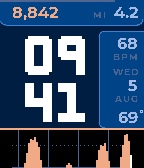
FacesYour hour drawn as landscape - and last night's sleep, before you get up. The bottom of the screen is the last sixty minutes: one column a minute, standing on the very bottom edge, with a quarter-hour graticule behind it and a dotted line at walking pace. Above it is the clock, as large as a 200-pixel screen will allow. Between them is one warm line: the horizon. Before you get up, the face shows you the night instead. Last night's sleep holds the step slot until you have actually moved - 350 steps by default, and adjustable. While it does, the chart's window becomes the night itself: sixty columns from the moment you fell asleep to the moment you woke, each one how much you moved, scaled so the most restless stretch fills the plot. The whole face runs cool until you cross that threshold, then warms the moment steps take the slot back. * Two layouts * Built-in default themes, plus full custom colors option. * Montserrat and other font options for the clock, each with a bold option. * Steps, heart rate - or the day's distance when there is no reading - the date, the temperature, and a two-pixel battery bar along the very top edge * Weather from Open-Meteo: no account and no API key. It follows your phone, or a city or postal code you type in, in which case it never touches phone location at all Built for Pebble Time 2. Every number in the layout is chosen for its 200x228 color screen.
 14
14Solfarer Atlas
Tools & UtilitiesTravel where you like. Solfarer Atlas is the Local Bubble as a place you can walk around: 2,236 real star systems within 100 light-years of Sol - Proxima Centauri, Barnard's Star, Wolf 359, Tureis, Guniibuu, and the rest - from the Hipparcos catalog, in their true spectral colors. No hourly schedule, no daily seed, nothing waiting for you. Where the Solfarer watchface walks one path chosen for you, the Atlas hands you the whole neighborhood: the map centers on wherever you're docked, and the 24 nearest stars are yours to cycle through, one button at a time. Each one has a page - spectral class, absolute magnitude, distance from Sol, the constellation it belongs to - and, more to the point, what the trip would cost you. Set course and go. Every journey is honest special relativity: a 1g burn to the midpoint, flip, and brake. The flight plays out as a twin-paradox cutscene with both clocks running at their true relative rates - 7.8 light-years to Wolf 359 ages the universe 9.5 years and you 4.5. Your career keeps the tally: how many hops, how far you've roamed, the farthest you've ever been from home, and how much younger you are than everything you left behind. * 2,236 real star systems, names, classes, and constellations included * The 24 nearest neighbors from wherever you stand - the neighborhood re-sorts every time you arrive * A lifetime ledger: hops, light-years, and the gap between your clock and the universe's * Set course for Sol from the title menu, from anywhere in the Bubble * Options on the watch, no phone needed: full, quick, or no flight replay; confirm before travel; a buzz on arrival; and a reset back to Sol * Sibling of the Solfarer watchface and the Lighthaul courier game - same bones, real galaxy The physics is real: exact time dilation, honest 1g rocketry in rapidity. The stars are real too. Go and see them.
 52
52Solfarer
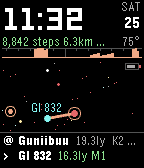
FacesWander the real stars. Every morning your ship starts at Sol, and every hour it hops to a nearby star - real ones, from the Hipparcos catalog: Proxima Centauri, Barnard's Star, Wolf 359, Tureis, Guniibuu, and 2,200 more systems of the 100-light-year Local Bubble, drawn in their true spectral colors. The map is a traveling 40-light-year viewport that rides the wander. The gold route sweeps to a different neighbor every minute; flick your wrist to browse the rest. When the hour strikes, the flight plays out as a twin-paradox cutscene - honest relativity at 1g: the universe ages 19 years while you age 6 on a 74-light-year run. A gold signpost always points home to Sol. By nightfall you're deep in the Bubble; at your chosen morning hour, you wake at Sol with a new day's journey ahead. It's a full watchface too: steps, distance, and heart rate beside the clock, a minute-by-minute activity sparkline of your past hour, weekday, date, and current temperature. A shake shows last night's sleep. Everything optional; the pure star chart is one toggle away. * 2,235 real star systems, names, spectral classes, and constellations included * Deterministic daily wander - miss an hour and it catches up instantly * Health data on the face; sleep on a wrist-flick; Open-Meteo weather * Configurable start-at-Sol hour and hop cadence (hourly or half-hourly) * Sibling of the Lighthaul watchface - same bones, real galaxy The physics is real: exact time dilation, honest 1g rocketry in rapidity. The twin paradox, one hop at a time.
 19
19Lighthaul Watchface
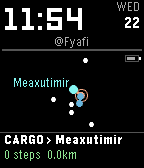
FacesThe Lighthaul star map as a watchface - and your ship flies itself. Every day a new procedurally-generated cluster arrives, seeded by the date: every pilot wearing this face flies the same galaxy. Every minute the gold route sweeps to a different contract offer. And on the hour (or half hour), the bell: your ship performs the run - the flight plays out as a little cutscene, universe clock and ship clock ticking at their true relativistic rates - then refuels, shops the dock's outfitter, and waits for the next bell. Each day is one complete career. Dawn starts you at $450 in a stock Courier; by evening you've got redline coils and you're chasing the deep-space halo. At midnight the day folds into your all-time records - best day, most deliveries, highest gamma, streak - and a fresh map arrives. Glance at your wrist: how's my pilot doing? If the face wasn't running, missed runs are simulated on return, so the day's state always matches the time of day - and everyone on the daily map stays comparable. * Time, date, battery, comms, and a fuel gauge, all watchface-proper * Tap or flick your wrist for a stats panel: rank, gamma, streak, records * Dispatch strategy, run cadence, cutscene verbosity, auto-outfitting, vibes - all configurable, always silent in Quiet Time * Chart-only mode: the living map without the economy - the freed space shows your steps, distance, and heart rate, and the gauge becomes your step goal * Same worldgen as the Lighthaul game and web game: a seed names the same stations everywhere * The dilation is real physics - exact time dilation, honest rocketry in rapidity The twin paradox as a complication on your wrist.
 23
23Trekv3 TimeSteel
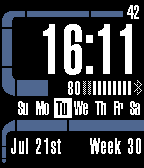
FacesAn LCARS-style watchface with a large clock, day-of-week strip, date, week number, battery meter and step count. Highly configurable: multiple colour themes, invert, 12/24h, seconds or AM/PM, week start day, Bluetooth and hourly vibration. Originally created by chops - this is a maintained fork that restores support for the older Pebble models (Pebble, Pebble Steel, Time, Time Steel, Time Round and Pebble 2). Note: weather is disabled by default, as the weather service this face originally used shut down in 2019.
 24
24Lighthaul
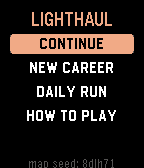
GamesHaul cargo and passengers between the stars at a hair under lightspeed - and let special relativity be the economy. Deadlines run on universe time. You and your passengers age on ship time. The closer to c you cruise, the less of your life each delivery costs - but fuel is delta-v, you pay again to brake, and every load's g-rating caps how hard you may burn. Gentle ramps cost years on both clocks. Pick contracts off the star chart. Outfit your ship: a bigger tank, a leaner drive, inertial dampers, a broker license, redline coils that push your top speed a nine closer to c. The autopilot flies each run optimally - how much fuel you buy is your throttle. Watch decades pass at the docks while you barely age. Retire rich, not old. * Procedural star clusters - replay any map by its seed, shared with the web game * A daily run: everyone flies the same cluster * Dock economy booms, strikes, and clearances * Reputation, ranks, and all-time records across careers * A deep-space license for pilots who touch gamma 25,000 The dilation is real physics - exact time dilation, honest rocketry in rapidity. The twin paradox as a contract clause.
 30
30ActiveHour2
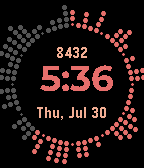
FacesThis watchface uses Pebble Health data to show the time along with a visual display of how active you are every minute of the hour. It is inspired by a Fitbit watchface. Includes the following options: - show date - show step count / sleep time (If selected, sleep time will show only when you want it to. Trust me.) - color schemes - show weather dot (Uses location - location is not used unless this is selected. Dot is shown at the minute mark that corresponds to current temperature.)