 4
4Stattwerk
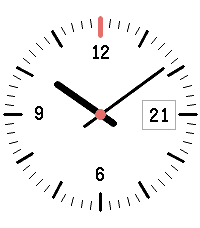
FacesThe Werkstatt dial on a light ground. Same face, same rules: an analogue watchface that does one thing — tell you the time, immediately. Large numerals, hands that differ clearly in length and width, hour marks that stand apart from minute marks, one accent colour for twelve o'clock and the pivot. The day of the month in a window at three. What differs is the ground. Werkstatt draws white on black; Stattwerk draws black on white. That is not a matter of taste alone. The Pebble Time 2 has a transflective display: in daylight it works by reflecting light, and the state that reflects is the light one. Outdoors on a bright day, a white dial is the one the screen was built for. At night, under the backlight, the dark one is easier on the eye. Which of the two you want depends on where you spend your day — so there are two, and you pick. Neither costs more battery than the other. The display draws power when pixels change, not when they are light or dark. Stattwerk redraws once a minute, exactly like Werkstatt. No second hand — that is a decision, not an omission. No weather, no step count, no configuration screen. The dial gets all the room. Free. No adverts, no account, no tracking, no network access of any kind — the watchface never talks to your phone. Source code available.
 12
12Werkbank
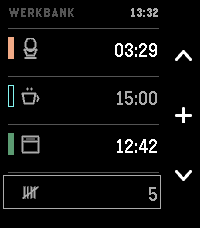
DailyThree timers and a tally counter, for when your hands are already busy. In a kitchen or a workshop you often can't look at a screen or type a label: your hands are covered in dough, or holding something. Three tracks, side by side. The question this screen answers is not "how long has this one got" but "which of these finishes first" — a comparison, so all three are shown at the same size and scale at once. A carousel hides two of them; a ring of arcs distorts them. This is a list. Each track has its own colour — the label you never have to set. USING IT Up / Down — choose a track. Select — set a time; or start, pause, resume, acknowledge. The middle icon always shows what the button will do next. While setting: Up and Down change the time, and holding a button runs through it. The step grows with the value — ten seconds under a minute, half a minute up to ten, then whole minutes. Select starts it. Back keeps the time without starting it. Select, held — give the track a pictogram. Eleven, each one a thing that takes time: an egg, a pot, an oven, a bowl for dough to rise, a cup to steep, a brush for paint to dry, a clamp for glue to set, laundry, a tablet, an hourglass for anything else, and a blank to remove one. Naming stays optional; a timer starts without a label, always. Down, held — reset. On a track that empties it, even mid-run; on the counter it returns to zero. Never a short press; the pictogram survives. No text entry — the watch has no keyboard. No configuration page either: roughly half of those in the Pebble catalogue no longer load. A running track has a filled bar, a set one a hollow bar. That difference is a shape, not a shade: in sunlight two bright tones stop being two tones, a shape survives. When a timer ends, the watch tells you which one, with its colour and its pictogram, and at what time it actually ended — not "now". If it was in a drawer when it happened, "now" would be a lie. This works with the app closed. It vibrates. It does not beep. The Pebble Time 2 is the first Pebble with a speaker, and a timer that sounds off in a shared kitchen is an intrusion into a room, not just a wrist. Silence is the default, not a setting to find. The counter at the bottom counts to 9999, one press each — rows, reps, batches, laps. No phone required, ever. No companion app, no network access, no account, no adverts, no tracking. Everything runs on the watch — which is also why nothing here can be switched off by a server in five years' time.
 4
4Puls
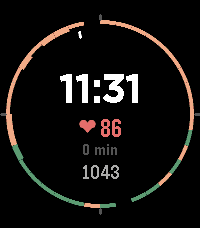
FacesA watchface that shows what your pulse has been doing, not just what it is now. The ring carries the last twelve hours of heart rate, read from what the watch already recorded. Position is the time of day, so the ring doubles as a twelve-hour dial. Colour is the heart rate, over four steps from your own quietest reading upward. Thickness is movement. Those are two different facts, not one twice, and together they answer something no single number can: whether your pulse was high because you were moving, or although you were sitting still. A red thin stretch is a statement. A red thick one is exercise. Where the watch has nothing, the ring stays empty. A gap means it was off your wrist, and it is never bridged — that would claim a measurement that never happened. In the middle, the last reading with its age beneath. "62" on its own claims the present tense; a reading from an hour ago would look exactly like one from a minute ago — the more dangerous display, because it looks right when it isn't. Tap the case for a fresh one. Continuous monitoring is what turns a month of battery into a few days, so this face does not do it. It samples every ten minutes — against the watch's own rate of about one reading every thirteen, that is thirty per cent more, not continuous. Switch on activity tracking and the denser readings are all used. Below the pulse, today's step count. No network access of any kind — the watchface never talks to your phone. Nothing to configure. Apart from the unit on the age, not a word on the face.
 11
11Solaris
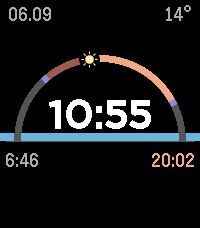
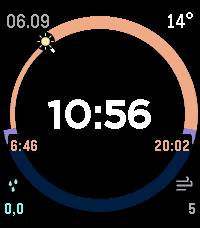
FacesA watchface that tells you where you are in the day. The arc spans all twenty-four hours: midnight left, noon at the top, midnight again right. The bright band is daylight — short in winter, long in summer, stretching with your actual latitude. Behind the sun lies the part of the day already spent; ahead of it, what is left. The boundary between them is now. There is no extra pointer, because none is needed. Under the horizon stand both sun times: sunrise on the left, sunset on the right, always in the same place. Colour says which comes next — amber for the one ahead, silver for the one behind. You never have to work out which event you are looking at. A second track shows when it will rain, on the same scale. Because both sit on one arc, you can see whether the rain falls inside the light you have left — something two separate readouts could never tell you. Sunrise, sunset and the sun's position are computed on the watch from the date and your location. Nothing is fetched, so nothing can be switched off. Lose your phone for a week and the arc is still right. Only the rain goes quiet. The band knows civil twilight too — the stretch where the sun is down but there is still light to read by. Above the Arctic Circle it does the honest thing: on a polar day the whole arc is lit, on a polar night none of it is, and no invented sunrise appears anywhere. At night the marker becomes the moon in its true phase. Set the watch to 24-hour time and there is not a single letter on the face. Free. No adverts, no account, no tracking. Weather from Open-Meteo
 13
13Horizon
FacesA watchface where the ring is the sun's path, not a scale of it. The sun travels a full circle, twenty-four hours over three hundred and sixty degrees. The horizon cuts it as a horizontal chord: above is day, below is night. This is not a picture of the sun's motion — it is the motion. The height of a point above the chord is a faithful rendering of true solar elevation. That buys something no number can. The chord moves with the season: low in summer, high in winter. Its height is the length of your day. Polar day and polar night are not special cases but the smooth ends of the same geometry — the chord becomes a tangent and the ring turns one colour. Anchored to solar noon rather than to the clock, sunrise and sunset sit at the same height on either side and the chord is horizontal by construction. Each time stands under its crossing. Civil twilight falls out of the same geometry — the elevation of minus six degrees, a second chord just below — so the violet stretch appears without anyone placing it. What is behind you is drawn thin, what is ahead in full thickness — a step, not a colour edge, so it reads in any light. The cycle starts at sunrise, so that step never lands mid-phase. Rain rides on the outer edge, always the next twenty-four hours. Below it, the rainfall to come and the wind speed; gusts of force 8 or more get a mark on the ring at the hour they are expected. Everything solar is computed on the watch. No letters anywhere. Free. No adverts, no account, no tracking. Weather from Open-Meteo
 9
9Almanach
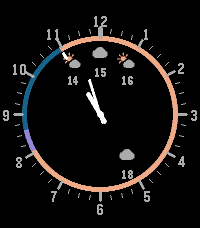
FacesA watchface that puts the next twelve hours on the dial you already know. The ring is both a clock face and a window: it carries the span from now to twelve hours ahead, and because that is exactly one revolution, it closes at the hour hand. Every position occurs once and only once — so "it rains at three" is unambiguous, without anyone having to say whether that means night or afternoon. The ring is coloured by the sky: amber for daylight, violet for civil twilight, blue for night. Sunrise and sunset are computed on the watch from the date and your location, for today and tomorrow both. Nothing is fetched for this, so nothing can be switched off. The weather hangs inside the ring, at the hour it applies to, with the temperature under it. Nine conditions, drawn so that the shape carries the difference rather than the colour: raindrops are long, snowflakes are stars, fog is the only sign without a cloud, and freezing rain is the only one standing on a ground line — because ice is not weather, it is what the pavement is doing. At night the sun in those signs becomes a crescent — always the same one, because real phases would leave it empty at new moon and turn it into a plain disc at full. Hours with gusts above force 8 carry a red edge along the ring. Wind is not a moment but a stretch of time, so it belongs on the time axis, not in a picture. No digital clock in the middle, nothing in the corners. The hands are short by design, so they never sweep across the forecast. Weather from Open-Meteo, CC BY 4.0.
 17
17Werkstatt
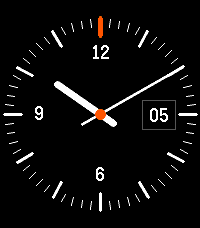
FacesAn analogue watchface that does one thing: tell you the time, immediately. Drawn natively for the Pebble Time 2's 200 x 228 display and sized to fill it — the dial reaches to within four pixels of the edge. No borders, no upscaling from an older screen. Everything here is contrast. Hour and minute hands differ clearly in both length and width, so a glance is enough and a second look is never needed. The hour marks stand apart from the minute marks. The numerals are large. It stays legible at arm's length, in daylight, and if you don't see colour well. One accent colour marks twelve o'clock and the pivot of the hands. Nothing else uses it. There is no second hand. That is a decision, not an omission. The display draws power when pixels change, so a sweeping second hand means sixty redraws a minute instead of one — and spends exactly the battery life you bought this watch for. This face redraws once a minute. There is no weather, no step count, no configuration screen. If you want those, there are excellent watchfaces that provide them. This one gives the dial all the room instead. The day of the month sits in a window at three o'clock. Free. No adverts, no account, no tracking, no network access of any kind — the watchface never talks to your phone.